Find out if your music will be turned down by YouTube, Spotify, TIDAL, Apple Music and more. Discover your music's Loudness Penalty score, for free.

Drag and drop an audio file here

Choose an audio file

MP3 or WAV

select a file

Your file will not be uploaded, stored or shared, meaning this process is secure and anonymous.

Online streaming services are turning down loud songs.

We all hate sudden changes in loudness - they're the #1 source of user complaints.

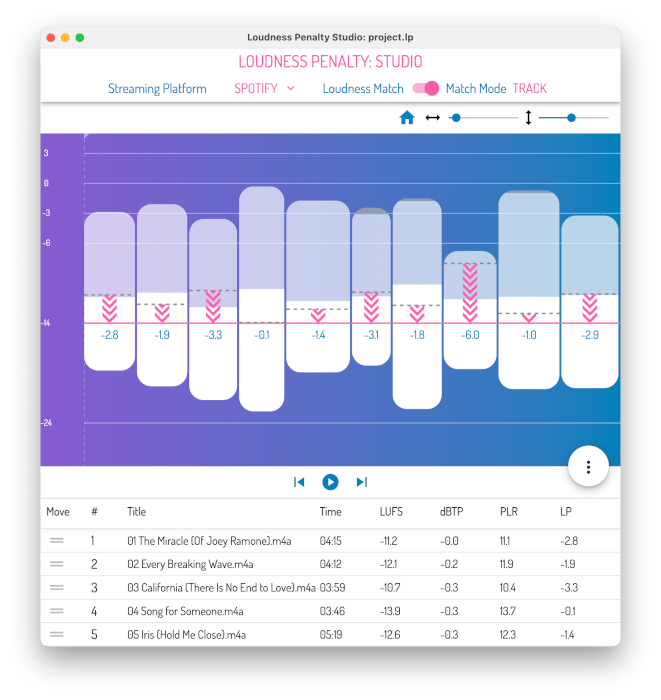
To avoid this and save us from being "blasted" unexpectedly, online streaming services measure loudness, and turn down music recorded at higher levels. We call this reduction the "Loudness Penalty" - the higher the level your music is mastered at, the bigger the penalty could be. But all the streaming services achieve this in different ways, and give different values, which makes it really hard to know how big the Loudness Penalty will be for your music...

Until now.

Simply select any WAV, MP3 or AAC file above, and within seconds we'll provide you with an accurate measurement of the Loudness Penalty for your music on many of the most popular music streaming services, and allow you to preview how it will sound for easy comparison with your favorite reference material.

Your file will not be uploaded, meaning this process is secure and anonymous.

Do you have any questions? Get in touch.
Processing audio

(but NOT uploading)

RESULTS (in dB)

0 YouTube
0 Spotify
0 TIDAL
0 Apple
0 Apple (Legacy)
0 Amazon
0 Pandora
0 Deezer

Want to take control of the Loudness Penalty for your music?

Find out how to optimize your music for impactful, punchy playback (and maximum encode quality) for all the online streaming services. Plus, receive a Loudness Penalty Report for your file that explains in detail what all the numbers mean.

Analyze another file

We just sent you an email with your report!

Analyze another file Visit MeterPlugs.com

No2 Lmvv038 New [ 99% CONFIRMED ]

Need to ensure that each section flows logically. Also, include recent data or studies to back up claims about NO2 levels and the effectiveness of interventions. Mention specific sources if possible, like the World Health Organization's guidelines or recent EPA reports.

I should start by confirming what LMVV038 is. I'll do a quick search in my mind. Wait, sometimes government or environmental agencies have model numbers for programs or initiatives. Maybe LMVV038 is part of a new initiative or policy related to NO2 emissions. Alternatively, it could be a typo or a specific code used in a research context. no2 lmvv038 new

I should also check if there are similar existing models or codes. For example, the Clean Air Act in the U.S. has various programs, and countries like China have specific air quality campaigns. Maybe LMVV038 is part of such a strategy. Need to ensure that each section flows logically

Now, structuring the essay. Start with an introduction explaining the importance of addressing NO2. Then, discuss what NO2 is, its sources, health and environmental impacts. Next, introduce LMVV038 as a novel approach. Discuss its components, how it works, maybe technological innovations, policy measures, or public engagement. Then evaluate its potential impacts, challenges in implementation, and compare it to existing strategies. Conclude with the significance of such initiatives in combating pollution. I should start by confirming what LMVV038 is

Scroll down to learn more about "Loudness Penalty"
Scroll down to learn what these numbers mean